The frequently cited comparison — that Bukit Timah Nature Reserve contains more tree species than the entire North American continent — comes from a 1986 study by biologist Richard Corlett, who counted approximately 840 native tree species in the reserve. North America, by comparison, has around 700. The figure has been updated and debated since, but the core point holds: a very small area of equatorial rainforest can pack in species diversity that no temperate forest can match.

The summit of Bukit Timah Hill, Singapore's highest natural point at 163.63 metres. Credit: Wikimedia Commons
What makes Bukit Timah primary forest
Primary forest — also called old-growth forest — is forest that has not been significantly disturbed by human activity. In Bukit Timah's case, the core area was protected from large-scale timber extraction as a water catchment reserve beginning in the mid-19th century under British colonial administration. This means the reserve contains trees over a century old, an intact multi-layered canopy and a soil microbiome undisturbed by bulldozing.
The dominant tree family in Bukit Timah is Dipterocarpaceae. Dipterocarps — named for their two-winged seeds — can grow to 60 metres or more and form the emergent layer that extends above the main forest canopy. Species such as Shorea curtisii (seraya) and Dipterocarpus grandiflorus (keruing) are found in the reserve, though many dipterocarps are now classified as threatened or locally rare because their original habitat across the Malay Peninsula has been heavily logged.
The reserve's recorded fauna
Bukit Timah and the adjacent Central Catchment function as a single ecosystem for most animal species. NParks surveys have recorded the following in or immediately adjacent to the reserve:
- Mammals: Sunda pangolin (Manis javanica), banded leaf monkey (Presbytis femoralis), long-tailed macaque (Macaca fascicularis), common palm civet, flying lemur (Galeopterus variegatus), lesser mousedeer
- Reptiles: Malayan water monitor, clouded monitor, reticulated python, mangrove pit viper (in lower areas)
- Birds: Over 170 species recorded, including the rufous-backed kingfisher, scarlet-backed flowerpecker, banded broadbill and the critically endangered straw-headed bulbul
- Invertebrates: More than 500 butterfly species have been recorded island-wide; the reserve holds a significant share of this diversity
The Sunda pangolin is listed as Critically Endangered on the IUCN Red List. Singapore holds a small but significant wild population in and around the Central Catchment forests. NParks conducts radio-tracking studies to monitor individual animals and identify high-risk road crossings.
Trail network and visitor access
The reserve is open to the public daily from 7am to 7pm. Four main trails radiate from the visitor centre at the base of the hill:
Summit Road Trail
The paved Summit Road is the main route to the hilltop. It is 1.7 kilometres one way and follows the original path used by the colonial-era signal station at the summit. The paved surface makes it accessible but also means it attracts the highest foot traffic of any route.
North View, South View and Seraya Trails
These three unpaved trails branch off from the summit road and loop through secondary and primary forest at different elevations. The Seraya Trail in particular passes through an area of mature seraya dipterocarps and is quieter than the main summit path. These trails require sturdy footwear as the soil becomes slippery after rain.
Catchment Path
The Catchment Path connects Bukit Timah to the Central Catchment Nature Reserve, passing through secondary forest that has been regenerating for several decades. It provides the most direct off-road link between the two reserves for hikers and is also used by the animal species that move between them.
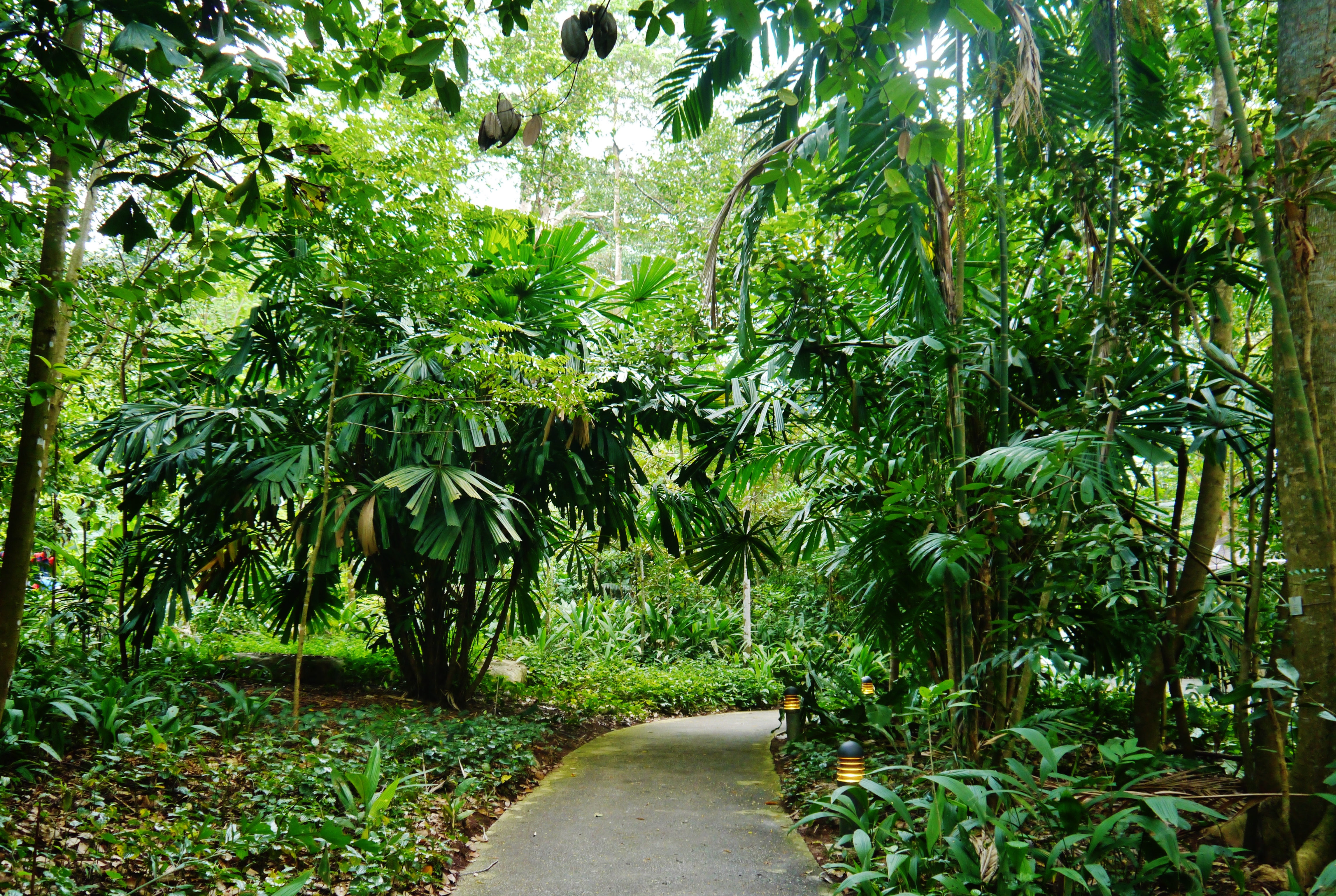
Forest interior at Bukit Timah Nature Reserve. Credit: Wikimedia Commons
History of protection
Bukit Timah was gazetted as a forest reserve in 1883, making it one of the earliest formally protected natural areas in Southeast Asia. The original motivation was water supply rather than ecological conservation: the British colonial administration recognised that forested catchments produced cleaner and more reliable water than cleared land.
The reserve survived World War II largely intact. Japanese forces used it as a military position during the Battle of Singapore in February 1942, and there are still concrete fortifications near the summit from that period. Post-war, urban development consumed most of Singapore's remaining forest, but Bukit Timah's water catchment status kept it protected.
In 1986, the year of the Corlett tree species study, the reserve was gazetted under the Parks and Trees Act, giving it a higher level of formal protection. It was declared a ASEAN Heritage Park in 2011.
Conservation pressures today
The reserve's small size — 163 hectares — is its primary constraint. Small populations of animals are vulnerable to genetic bottlenecks, disease and local extinction events. The banded leaf monkey population at Bukit Timah numbers only a few dozen individuals. When a respiratory illness affected the population in the 1990s, numbers dropped significantly before recovering.
Trail erosion is a secondary issue. The summit road and popular trails have compacted soil that sheds rainwater rapidly, increasing runoff into the reserve's stream systems. NParks has installed drainage structures and planted groundcover along trail edges to slow this process.
The Eco-Link@BKE, opened in 2013, directly addresses the connectivity problem by creating an overhead crossing above the Bukit Timah Expressway. Camera trap data shows consistent animal use of the link across multiple mammal species.
Visitor conduct guidelines
NParks publishes specific rules for reserve visitors. Among the most ecologically significant:
- Feeding wildlife is prohibited — it habituates animals to human presence and can alter their ranging behaviour
- No drones — aerial disturbance stresses nesting birds and roosting bats
- Stay on marked trails — leaving trails compacts soil and exposes roots
- No plant collection — removing specimens, even fallen leaves, depletes the reserve's biological material over time
The reserve's visitor centre at the base provides trail maps, biodiversity exhibits and rangers who answer questions. The centre was upgraded in 2014 and includes a display on the reserve's geological history, which dates to the formation of the main Singapore granite batholith over 200 million years ago.