Most international visitors associate Singapore's natural side with Bukit Timah's rainforest or the Gardens by the Bay plantings. Fewer make the journey to Kranji in the northwest, where Sungei Buloh Wetland Reserve edges the Strait of Johor. This is a quieter, muddier, saltier kind of nature — one that functions primarily as a staging post for birds moving between Siberia and Australia.
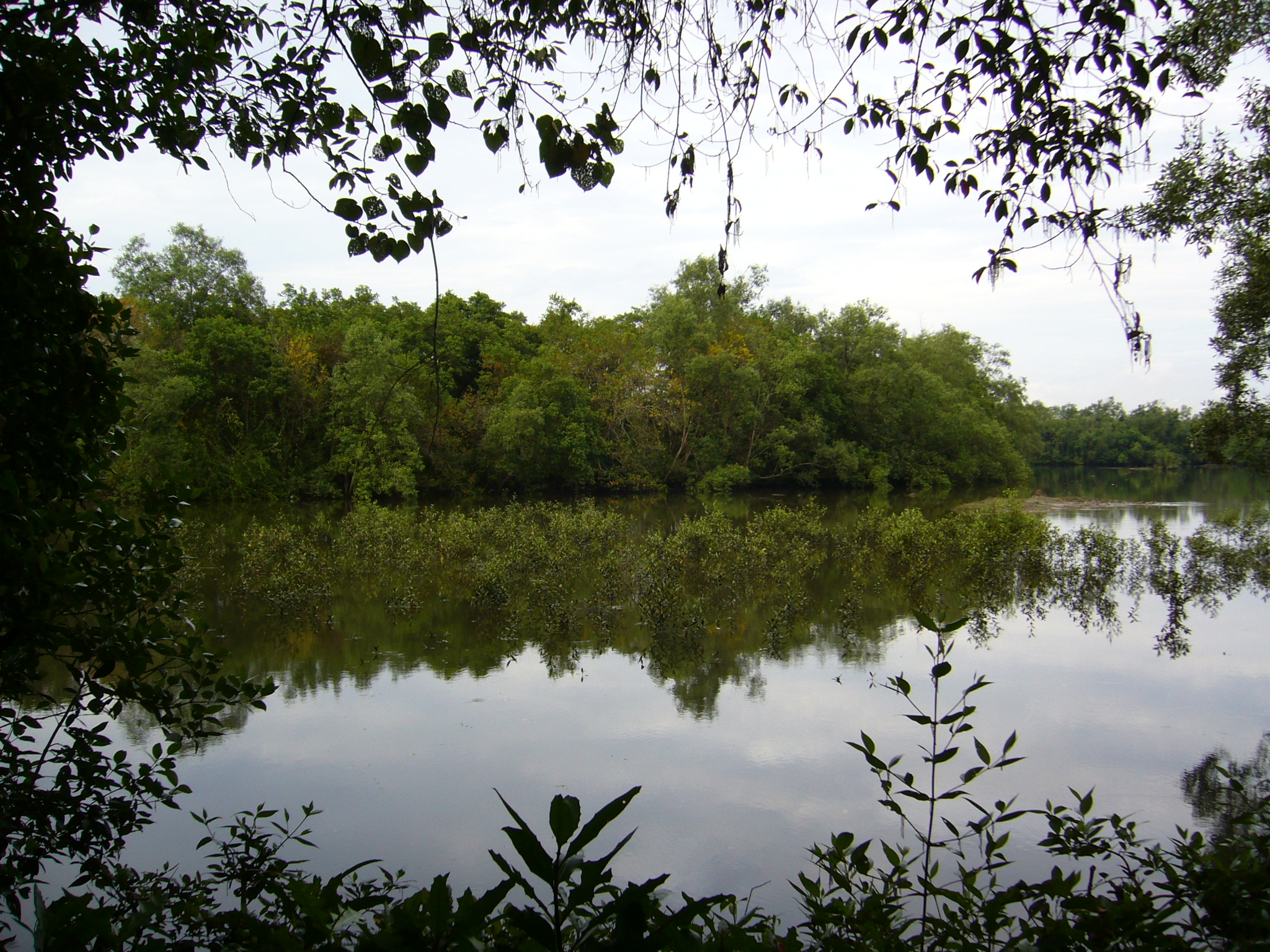
Looking across the mangrove and mudflat at Sungei Buloh Wetland Reserve. Credit: Wikimedia Commons
Geography and habitat types
The reserve encompasses several distinct habitat zones that support different species assemblages:
- Mangrove forest: The largest single habitat type, covering the tidal margins. Species include Rhizophora apiculata, Avicennia officinalis and Bruguiera gymnorrhiza. Mangrove trees have adapted to saline, anoxic soils through specialised root systems — prop roots in Rhizophora species and pneumatophores in Avicennia — that allow gas exchange above the waterline.
- Intertidal mudflat: Exposed at low tide, the mudflats are feeding grounds for shorebirds. The mud is rich in polychaete worms, small crustaceans and molluscs. The tidal cycle effectively delivers fresh food across the mudflat surface twice daily.
- Freshwater ponds: Created from former prawn ponds, these support resident waterbirds year-round. Purple herons, little egrets and black-crowned night herons breed in the reserve, and the ponds attract kingfisher species from four different genera.
- Secondary forest and grassland patches: At the reserve's inland edges, secondary vegetation provides nesting sites and fruit resources for forest-edge species.
The East Asian–Australasian Flyway
Singapore lies along one of the world's eight major bird migration flyways — the East Asian–Australasian Flyway (EAAF), which runs from breeding grounds in Siberia, Alaska and northern China to wintering areas in Australia and New Zealand. Over 50 million waterbirds use this flyway annually, including species that are globally threatened due to habitat loss along the route.
Sungei Buloh provides a stopover point roughly midway along the flyway. Shorebirds arrive from August through October on their southward migration and pass through again between March and May heading north. The reserve's mudflats allow birds to refuel before continuing.
Key migratory species at Sungei Buloh: Common sandpiper, whimbrel, red-necked stint, Pacific golden plover, grey plover, common greenshank. In years when food resources align with migration timing, the mudflat can hold several hundred individuals of a single species simultaneously.
Resident wildlife
Outside migration season, Sungei Buloh supports a resident community of species that depend on coastal mangrove year-round.
Saltwater crocodile
The reserve is one of the few places in Singapore where saltwater crocodiles (Crocodylus porosus) are reliably sighted. The population here is small — typically two to four individuals — and NParks monitors movements through camera traps and community sightings. These are likely individuals that have moved across the strait from Malaysia's Johor coast. Saltwater crocodiles are the world's largest living reptile species and are fully protected in Singapore.
Estuarine fish and mudskippers
The tidal channels within the reserve support several mudskipper species, particularly the giant mudskipper (Periophthalmodon schlosseri), which is common on exposed mud at low tide. Mudskippers are amphibious fish that breathe through their moist skin and the lining of their mouth and throat, allowing them to spend extended periods out of water. They are visible year-round on the boardwalk sections of the reserve.
Smooth-coated otter
Smooth-coated otter (Lutrogale perspicillata) groups have been observed hunting in the reserve's tidal channels. Singapore's otter population — primarily the two urban family groups centred on the central waterways — has expanded in recent years, and coastal reserves such as Sungei Buloh see occasional visits from roaming subadult males.

Mangrove forest interior at Sungei Buloh. Prop roots of Rhizophora species are visible at the water's edge. Credit: Wikimedia Commons
History of the reserve
The site was used as farmland and prawn aquaculture ponds through much of the 20th century. In the late 1980s, proposals to develop the area for light industry were countered by a nature conservation campaign led by the Malayan Nature Society (Singapore). The government agreed to gazette the area as a nature park in 1989, and it was formally opened as the Sungei Buloh Nature Park in 1993.
The reserve expanded to its current 202 hectares in 2002 and was redesignated as a Wetland Reserve. It received ASEAN Heritage Park status in 2003, the first site in Singapore to receive this designation.
Trail network
The reserve has two primary trail circuits:
- Main Trail (1.3 km): A circular boardwalk and path system passing the freshwater ponds, mangrove boardwalks and the main mudflat observation shelter. Accessible to strollers and wheelchairs along most sections.
- Aerie Trail (1.1 km): An extension into secondary forest with an elevated platform giving views over the mangrove canopy. This trail closes at different times depending on wildlife activity.
The reserve's main visitor centre near the Kranji MRT station area includes exhibits on the mangrove ecosystem, the EAAF and the reserve's conservation history. The best time to observe shorebird activity is within two hours of low tide, when mudflats are exposed but not yet fully drained.
Connection to the wider coastal corridor
Sungei Buloh sits at the western end of a proposed Kranji-Mandai ecological corridor that NParks has identified as a priority area. To the east, the Kranji Reservoir and Kranji Marshes support additional wetland habitat. The marshes, partly managed through reed-cutting and water level adjustments, are a separate reserve that supplements the shorebird and waterbird populations of Sungei Buloh.
The potential corridor to Mandai — where the Singapore Zoo, Night Safari and River Wonders facilities border the Central Catchment Nature Reserve — would create a continuous green edge along the northern coastline. This has significant ecological value because the northern shore retains more intact mangrove than any other part of Singapore's coast.